

Food…‘friend or foe’…?
What a great way to start finding out about IgG food sensitivity testing, discovering how your immune system recognises the food you eat and how it reacts with your gut.
In this episode, Anna sits down with one of the industry’s leading figures, Dr Nigel Abraham, and talks through what IgG testing is and what is actually being tested.
By the end of this episode you'll know:
- IgE vs IgG
- Tolerance isn't fixed — why the immune system moves in and out of it
- What's actually driving an IgG response
- The three-step clinical process
- Why the nutritional consultation matters just as much as the test result itself
Our Chat IgG podcast takes food sensitivity testing from the lab to your clinic. Hosted by industry leading figures Anna Pugh and Dr Nigel Abraham, we’ll take you on a discovery journey across 10 episodes looking at everything from immunology to the clinical process. A must listen to series for absolutely anyone and everyone that wants to learn and understand IgG food sensitivity testing.
Listen on Spotify
Transcript
Anna: So, when I finished my nutrition degree I really thought I had a solid handle on what allergies were all about. But two questions kept nagging at me and one of them was if I eat a little bit of something I'm sensitive to is that really a problem and certainly why if I reacted to a food one day and I didn't react to the next day does that mean I've got an allergy or a sensitivity? What is going on here? So, I suppose my first question is starting right at the beginning Nigel. People hear the word allergy, but what does allergy actually mean?
Nigel: I guess that's probably the most important question because what we have is two very different types which are often referred to as allergy, but they are very very different. So, we need to discuss what they are and what the differences is. So, the first type is what is referred to as IgE allergy so remember that that's IgE. This is essentially our classical type of allergy. You know somebody who is very sensitive to peanuts when they ingest even the smallest amount of peanut, will have what's regarded as an immediate reaction and in some cases a very violent reaction and this is triggered by this special type of antibody the IgE antibodies. It's the most common form of what we call allergy so people who suffer from hay fever and animal reactions are all the same mechanism you make this antibody to whatever it is you're allergic to. And as we said it's characterised by an immediate reaction often a very strong reaction and most importantly this is largely genetic. So, it's lifelong no matter how long you avoid what you're allergic to if you and you know accidentally ingest it you can have a severe reaction. And there have been notable examples of that regrettably in the news and that in extreme cases it can even be fatal.
Anna: That's interesting because as an eczema sufferer, I've always had IgE allergies. In terms of food, it's been egg white, but I developed an IgE allergy to latex in my pregnancy and perhaps we can talk about losing tolerance at different times of our life, but I've developed other allergies later on in life.
Nigel: That's very interesting and generally speaking this type of allergy we still talk about classical allergies it usually begins in early childhood. Even as babies you're developing reactions. So, we often find that as an adult you had a history when you were very young of reacting for example to milk but because you're prone to allergies over time as an adult you can develop new reactions that you didn't have before. And of course, pregnancy from an immune perspective changes everything.
So, there are examples of people developing allergy and other people whose allergies disappear.
Anna: Okay well that's good news in itself certainly for parents of children with type 1 allergies. Okay, so let's go back to what we're testing because we're testing for, I believe the term is type 3 allergies delayed immune response IgG. So, tell us a little bit about the mechanisms behind IgG allergic reactions as distinct from IgG.
Nigel: Yeah, this is the most important point because you've already used the term allergy. So from a textbook perspective it is a form of allergy, but it is very different to IgE allergy that we've just been speaking about. So, IgG responses now are characterised with being very delayed so instead of minutes your reactions can often be measured in terms of days which of course makes it really difficult for you to pin down what is it that I ate that actually resulted in that reaction. And as we see later on that's where testing comes in. So, what we're measuring here is IgG antibodies. These are a normal immune response to everything that is foreign to us and the truth is that food is foreign to us, it's something we have to consume but we have a very uneasy relationship. And what we see is, look our immune system can go in and out of tolerance through a whole variety of reasons which we will talk about. Where one minute, you're tolerant and that food doesn't seem to be causing any problems and then the next minute it's now causing a reaction. This is a common issue and that is to some degree why testing is important is to find out at any given point the food that we're commonly eating, just what is our immune system doing to it, is it treating it as a friend or is it treating it as something abnormal that needs to attack.
Anna: Yeah, that's really interesting which means that our response is changing all the time it's not static. So really what you're saying is our tolerance changes constantly throughout life. So, if we did a FoodPrint test one year and we did it three years later with different circumstances, we're going to get different results depending on our immune tolerance at that point.
Nigel: Yeah, that's the main characteristic of IgG responses is that they are transient and they change over time. Because the truth is our response to the food that we eating is driven by our environment, it's driven by all those environmental factors
that we expose ourselves to. The infections, the types of food that we're eating,
all of those determine whether we are going to react or not react. So, unlike IgE
true allergies which is a lifelong situation, people who have IgG sensitivities are a
a transient thing. So, at this point in time, it may be a problem but with the right therapy and the right testing you can get back to tolerating those foods and it's no longer a problem again.
Anna: That's really interesting, so that does cover what type of symptoms occur with IgG food sensitivities. I presume there's a myriad of symptoms because they're not so obvious and immediate. They can, I mean can you give me an example of the types of symptoms you're going to experience or what are the most common symptoms you're going to experience when you have food sensitivities.
Nigel: That's a bit of a problem when it comes to food sensitivity because as you've already said the truth is when you say well what symptoms can I expect. Just about everybody's system is influenced by a food sensitivity reaction because when you make these abnormal levels of these IgG antibodies what they do is they drive inflammation. This low-level background inflammation but what that does is
it manifests itself in a whole variety of symptoms. Now, obviously GI problems are the most obvious example, IBS like symptoms are very common. But the truth is that we could be looking at skin reactions, migraines are very common or certain types of migraines and then because it's inflammatory you can have things like joint reactions as well. So, when you do surveys of people who have had this type of test
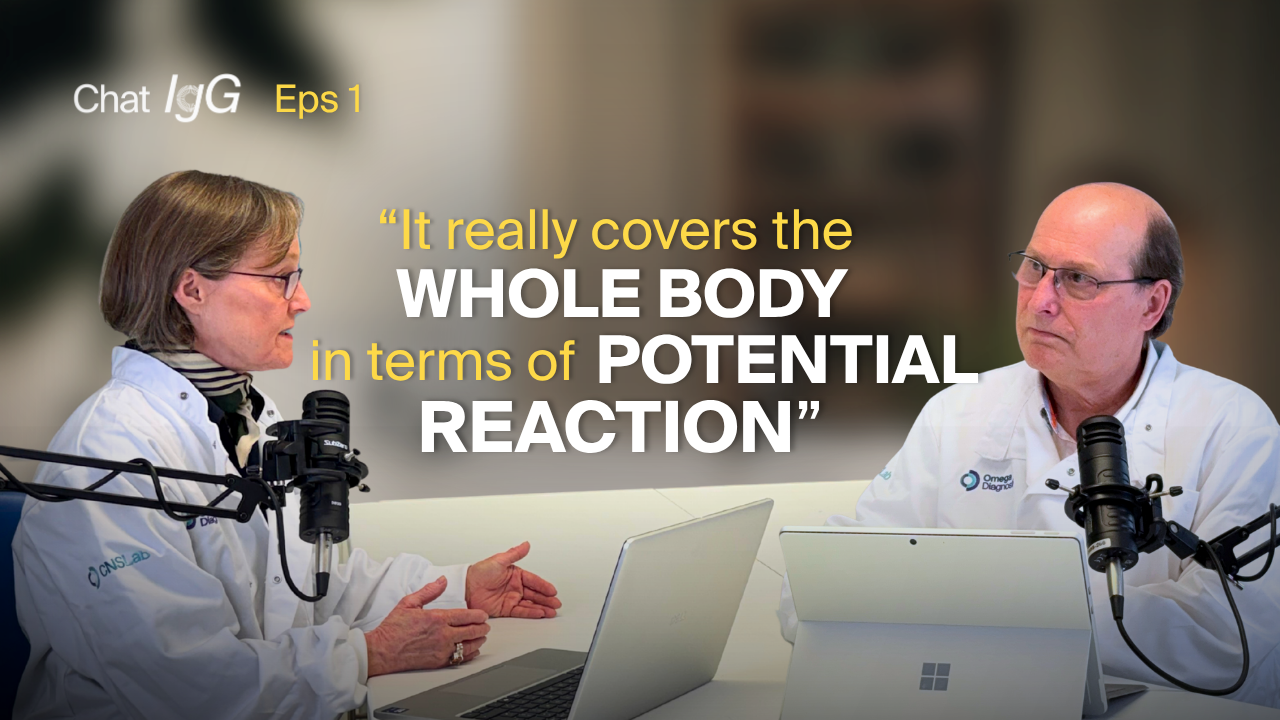
and ask them what symptoms did you have, why did you have this test, it really covers the whole body in terms of potential reactions.
Anna: Okay, so where there is potential inflammation at the core that's what we're looking at. Where symptoms are driven or potentially driven by inflammatory responses.
Nigel: Absolutely, yes. That's how these antibodies themselves can't actually cause a problem. It's the antibodies driving inflammation that's the issue.
Anna: And what I've taken from that is that producing IgG antibodies is a normal response to eating foods because the immune system is testing out those different proteins in the blood it's a constant test and a challenge. So, to have IgG antibodies in the system is a normal response to foods eaten but what is not normal and what we're testing is this highly elevated response to certain proteins or antigens.
Nigel: Yeah, that's an important point to understand because one of the criticisms
if you like of testing is that these IgG antibodies is just a normal response. And as I said earlier to some degree, they are because it is our normal protective mechanism. But under a normal tolerant situation where you're not having a reaction
to the food that you're eating, you have a low level of antibodies. What the testing is doing is identifying foods that you have significantly elevated levels to which shows you're having an active immune response to that particular food.
Anna: Okay and so, the whole point of an IgG elimination program is to isolate and detect those foods that are raising a higher immune response and then eliminate them for a short period and then presumably you've got to bring those foods back in. Now the reason that I'll stop at that point is because detecting and testing is great, you see what foods are stimulating that immune response. You then isolate which ones to remove from the diet but how long for, let's just stay there. How long should we be taking these specific foods out for in order for that IgG response to reduce or normalise.
Nigel: Yes, again this comes back to our two types of allergy. IgE allergy, our classical allergy no amount of avoidance is going to change your reaction in fact sometimes it can make it worse. But with IgG where it's all about exposure, what we can do with testing is identify the things which have the highest reactivity at this point in time. And then through dietary manipulation we can take those most reactive foods out of the diet. It's important that this isn't a quick fix, your immune system and antibodies are hanging around for quite some time, so we're talking about probably a 3 to 6 months program where you should start seeing improvement by removing those most reactive foods. And of course, once we've regained tolerance and we're no longer reacting then we can structurally reintroduce that food again. So, this is that crucial difference, IgE you can never have that food, IgG responses get back to a healthy gut environment and you can start reintroducing those foods again.
Anna: Yes, I do find that as a practitioner the reintroduction phase is something that people do not want to do. Especially when they've had really good remission from symptoms and they don't want to bring those foods back in and stimulate those symptoms.
Nigel: Yeah, I completely understand that.
Anna: Absolutely.
Nigel: You've had bad experience; you don't want to do that again. But I would say that's where testing comes in.
Anna: Yeah.
Nigel: If you're just going to blindly decide when to introduce food and hope for the best you run that risk. Testing gives us the precise ability to look at what response you have at that point in time.
Anna: Yeah, and then by bringing those foods back in after a minimum of 3 months, you're challenging your tolerance threshold with each food aren't you. That's what you're doing by bringing it back in.
Nigel: Yes.
Anna: And the only way to challenge it is to bring the foods back in.
Nigel: It's the only way you're gonna know whether you fix the problem isn't it.
Anna: Yeah, exactly.
Nigel: I would say that and from your own experience I'm sure you're the same is that you know you don't just reintroduce everything at once yeah. You have to be sensible about it, but theoretically yes if the gut environment has fixed itself you can start reintroducing these foods and hopefully it won't be a problem in future.
Anna: Yes, and I think reintroduction I think that's probably the topic for a whole podcast because it's quite difficult to reintroduce foods. I've just had a client, just spoken to a client before this podcast whose child has been off dairy for the last
year and a half. And she wanted some information about how to reintroduce dairy
because her child's symptoms had reduced particularly gastrointestinal and skin problems and she was nervous to bring the foods back in. So, we discussed how to grade those foods back in gradually one portion a day for five days. And actually, with dairy is different from other foods I think so we started with cheese. Bring that in and then move on to yogurt and then move on to whole milk. So that reintroduction phase is really challenging for a lot of people. It's a little bit, I call this elimination diet is often a little bit of a honeymoon period when people take the foods out because they get wonderful symptom relief, but they don't want to bring the foods back in. And this is where as a practitioner I find you need to really hold the hands of your clients because you need to encourage them to bring the foods back in in order to challenge their threshold to each food.
Nigel: Yeah.
Anna: And dairy and eggs is often quite difficult to do and other foods less difficult to do. And I you know we say one portion a day for five days is enough to stimulate that IgG response and notice symptoms. And generally they will notice something within five days.
Nigel: Absolutely.
Anna: Yeah.
Nigel: I think it's also important to understand the importance of that consultation
the nutritional consultation. Because every food is different, we can use testing to show the most reactive foods but at the point that you how when you introduce them is probably different from for different foods. And of course, everybody's individual the way we respond to foods is an individual process. That's why I think it's so important that this type of testing is in combined with that nutritional consultation.
Anna: Yeah. No, I agree and that's original, let's go back to the original case history.
The skill of a practitioner in taking good case histories is your first step, your first crucial step absolutely. Choosing the right test to underpin is also really important
but again, holding your client's hand as you go through the process is really important. Particularly when you're talking about diets and changing diets and you know the nice guidelines say that no, there should be no dietary manipulation without careful clinician support. And I think that's really really important and I think as practitioners we know that you don't want to let go of your client when they're about to do something difficult which is remove foods, take foods out of the diet and then reintroduce them. It's a difficult process for someone to go through, it needs help definitely. Okay, so we talked about removing foods just a little bit we'll touch again we'll talk about this at length another time, but when you've taken the foods out, presumably you've removed a major trigger or potential trigger. And I talk about the fact that we need to support gut function while at the same time is removing the foods. So, supporting gut integrity is very important, would you agree with that? Does that go hand in hand with eliminating foods?
Nigel: Yeah, absolutely. One thing we haven't mentioned is, we've said that in food sensitivity you have high levels of IgG antibodies, but why is that happening? That's all about exposure that's where your immune system has been exposed to the food that we're eating. And that happens because of what's called increased gut permeability which is commonly referred to as leaky gut syndrome. And what happens is that the mucosal lining of the gut opens up and starts letting large food molecules through which shouldn't normally happen. And when that happens
that's what drives this IgG response. So when we're looking at treatment options
obviously, we need to identify the foods that are causing the problem, temporarily remove those but we also need to address why it happened in the first place. So we need to look at how we can heal the gut and strategies to make the immune system more or less reactive.
Anna: Well, that's really interesting and that's a great way to kind of wind up the first podcast because we're talking about a three-step process. The first step is testing, choosing foods to eliminate and the second the second one is to secure gut function and work on the gut integrity at the same time and the third stage is reintroducing the foods when hopefully we've improved tolerance and gut integrity so there's less gut intestinal permeability and leaky gut. So, it's really quite an important three stage process and I think the gut, as we know the gut microbiome, gut intestinal permeability is extremely important for health anyway. So that's a nice way to finish with this first podcast, thank you Nigel. You carefully explained the difference between IgE type 1 allergy, IgG, the concept of tolerance to foods and how IgG response is a normal response to foods, but what is not normal is this elevated response. But we can do something about it by removing those foods, securing gut function, looking after the gut and then bringing those foods back in a staged process in order to challenge tolerance. Thank you very much.
Nigel: You're welcome.